



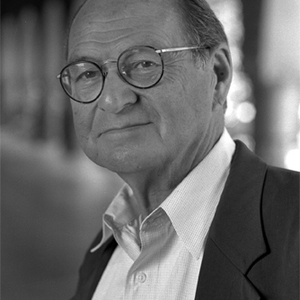
Robert Zajonc
IN MEMORIAM
Professor Robert Zajonc (pronounced ZYE-unts) died of pancreatic cancer on December 3, 2008, at his home in Palo Alto, California. Social Psychology Network is maintaining this profile for visitors who wish to learn more about Professor Zajonc's work. For more information, please see below:
- Robert Zajonc, Who Looked at Mind’s Ties to Actions, Is Dead at 85 (New York Times)
- Robert Zajonc, pioneer of social psychology, dies at 85 (Stanford University)
- Memories of Robert B. Zajonc (Association for Psychological Science)
- Robert B. Zajonc (1923-2008) (American Psychologist)
- Robert Zajonc, professor of psychology, dies (SFGate)
- Robert Zajonc (University Record Online)
- In Memory of Robert Zajonc (Federation of Associations in Behavioral and Brain Sciences)
After obtaining his Ph.D. from the University of Michigan in 1955, Robert Zajonc became a professor there until 1994, having held the positions of Director of the Institute for Social Research and Director of the Research Center for Group Dynamics. He then joined the faculty at Stanford University, where he is currently Professor Emeritus of Psychology.
Throughout his long and distinguished career, Professor Zajonc has had research interests in basic processes implicated in social behavior, with a special emphasis on the interface between affect and cognition. In a series of well-known studies, he examined circumstances under which affective influences can take place in the absence of cognitive contributions.
For this ground-breaking work Professor Zajonc has received a number of honors, including Doctorates Honoris Causa from the University of Louvain, the Society for Experimental Social Psychology Distinguished Scientist Award, and the APA Distinguished Scientific Contribution Award.
Primary Interests:
- Attitudes and Beliefs
- Causal Attribution
- Emotion, Mood, Affect
- Neuroscience, Psychophysiology
- Social Cognition
Note from the Network: The holder of this profile has certified having all necessary rights, licenses, and authorization to post the files listed below. Visitors are welcome to copy or use any files for noncommercial or journalistic purposes provided they credit the profile holder and cite this page as the source.
Image Gallery
Video Gallery

Toasts to Bob (The Robert B. Zajonc Institute of Social Studies)
The Mere-Exposure Effect
Books:
- Izard, C., Kagan, J., & Zajonc, R. (Eds.). (1984). Emotions, cognition, and behavior. Cambridge, UK: Cambridge University Press.
- Zajonc, R. B. (1980). Social psychology: An experimental approach. California: Brooks/Cole.
- Zajonc, R. B. (1969). Animal social psychology: Reader of experimental studies. New York: Wiley.
- Zajonc, R. B. (2003). The selected works of R. B. Zajonc. New York: Wiley.
Journal Articles:
- Herrera, N. C, Zajonc, R. B., Wieczorkowska, G., & Cichomski, B. (2003). Beliefs about birth rank and their reflection in reality. Journal of Personality & Social Psychology, 85(1), 142-150.
- Kunst-Wilson, W. R., & Zajonc, R. B. (1980). Affective discrimination of stimuli that cannot be recognized. Science, 207(4430), 557-558.
- McIntosh, D. N., Zajonc, R. B., Vig, P. S., & Emerick, S. W. (1997). Facial movement, breathing, temperature, and affect: Implications of the vascular theory of emotional efference. Cognition & Emotion, 11(2), 171-195.
- Monahan, J. L., Murphy, S. T., & Zajonc, R. B. (2000). Subliminal mere exposure: Specific, general, and diffuse effects. Psychological Science, 11(6), 462-466.
- Murphy, S. T, Monahan, J. L., & Zajonc, R. B. (1995). Additivity of nonconscious affect: Combined effects of priming and exposure. Journal of Personality & Social Psychology, 69(4), 589-602.
- Murphy, S. T., & Zajonc, R. B. (1993). Affect, cognition, and awareness: Affective priming with optimal and suboptimal stimulus exposures. Journal of Personality & Social Psychology, 64(5), 723-739.
- Raven, B. H., Zajonc, R. B., & Kupper, D. A. (2003). Harold B. Gerard (1923-2003). American Psychologist, 58(10), 811.
- Winkielman, P., Zajonc, R. B, & Schwarz, N. (1997). Subliminal affective priming resists attributional interventions. Cognition & Emotion, 11(4), 433-465.
- Zajonc, R. B. (1980). Feeling and thinking: Preferences need no inferences. American Psychologist, 35(2), 151-175.
- Zajonc, R. B. (1993). The confluence model: Differential or difference equation. European Journal of Social Psychology, 23(2), 211-215.
- Zajonc, R. B. (2001). Birth order debate resolved? American Psychologist, 56(6-7), 522-523.
- Zajonc, R. B. (2001). The family dynamics of intellectual development. American Psychologist, 56(6-7), 490-496.
- Zajonc, R. B. (1965). Social facilitation. Science, 149(Whole No. 3681), 269-274.
- Zajonc, R. B. (1985). Emotion and facial efference: A theory reclaimed. Science, 228(4695), 15-21.
- Zajonc, R. B. (1976). Family configuration and intelligence: Variations in scholastic aptitude scores parallel trends in family size and the spacing of children. Science, 192(4236), 227-236.
- Zajonc, R. B. (1989). Styles of explanation in social psychology. European Journal of Social Psychology, 19(5), 345-368.
- Zajonc, R. B., & Mullally, P. R. (1997). Birth order: Reconciling conflicting effects. American Psychologist, 52(7), 685-699.
